The best way to preserve a story isn't always to write it down. We compare eight options for capturing voices, making memory books, organizing family archives, and bringing meaningful moments to life.
Reviewed November 10, 2026 · By the ECOS Editorial Team
You probably have hundreds of photographs on your phone. But can you remember the conversation just before the picture was taken? Why your father moved to a different city? The joke your grandmother always told? What you felt the day your life changed?
Pictures keep a scene. Stories preserve the meaning behind it. A growing range of AI-assisted memory apps can help people capture those stories—but they are not interchangeable. Some are made to produce a hardcover book. Some gather contributions from an entire family. Others make recordings searchable. And some help you keep telling new stories as life happens.
Our pick for living, conversational storytelling is ECOS. It helps you tell stories naturally, organize them, and turn their meaningful moments into narrated visual Echoes that you can revisit or share. For a printed memoir, collaborative gift, or landline-friendly recording experience, another product may fit better.
Editorial disclosure: This guide is published by ECOS, which appears first in the comparison. Rankings reflect fit for specified use cases, not an independent laboratory test. Features and public prices were checked against providers' websites on November 10, 2026; they can change.
Quick comparison: which memory app is right for you?
| App | Best for | What you create | Starting price or model* |
|---|---|---|---|
| ECOS | Living stories and visual, narrated moments | Evolving stories and shareable Echoes | Free to start; Premium price shown in app |
| Remento | A book that keeps the original voice | Hardcover with QR-linked recordings | $99 initial package |
| MILA Stories | A multi-person family tribute or gift | Collaborative digital or printed memory book | Digital from $19; print from $59 on current pricing page |
| Memory Murals | A searchable family archive | Organized photos, recordings and stories | Free; Premium $12.99/month or $99.99/year |
| StoriedLife | A conversational autobiography | Narrated chapters and optional book | Digital from $59 first year |
| Storii | Relatives who prefer a regular phone call | Recorded and transcribed life-story calls | Subscription; confirm checkout price |
| Tell Mel | AI-led phone interviews | Audio and written living memoir | First year from $39 |
| Storyworth | A guided memoir and family keepsake | Weekly stories and hardcover book | Memoirs plans; check live pricing |
USD prices where shown, before applicable taxes, add-ons or regional differences. MILA has different amounts on some of its product and help pages; confirm your selected product and country at checkout. Storyworth's own pricing page currently shows inconsistent amounts in different sections, so we have not quoted a single price.
How we evaluated the apps
We compared publicly documented experiences across six practical questions: (1) how easy it is to start speaking; (2) whether the system helps shape a story; (3) whether stories can grow or be edited later; (4) what the final output looks or sounds like; (5) how family sharing works; and (6) whether pricing, privacy and portability are clearly explained. We did not perform hands-on testing of every competitor or independently audit security, accuracy or long-term durability. “Best” below means best fit for that need, not an objective universal winner.
1. ECOS — Best for living, visual storytelling
Best for: People who want to preserve their experiences as stories they can keep developing—not just create a one-time keepsake.
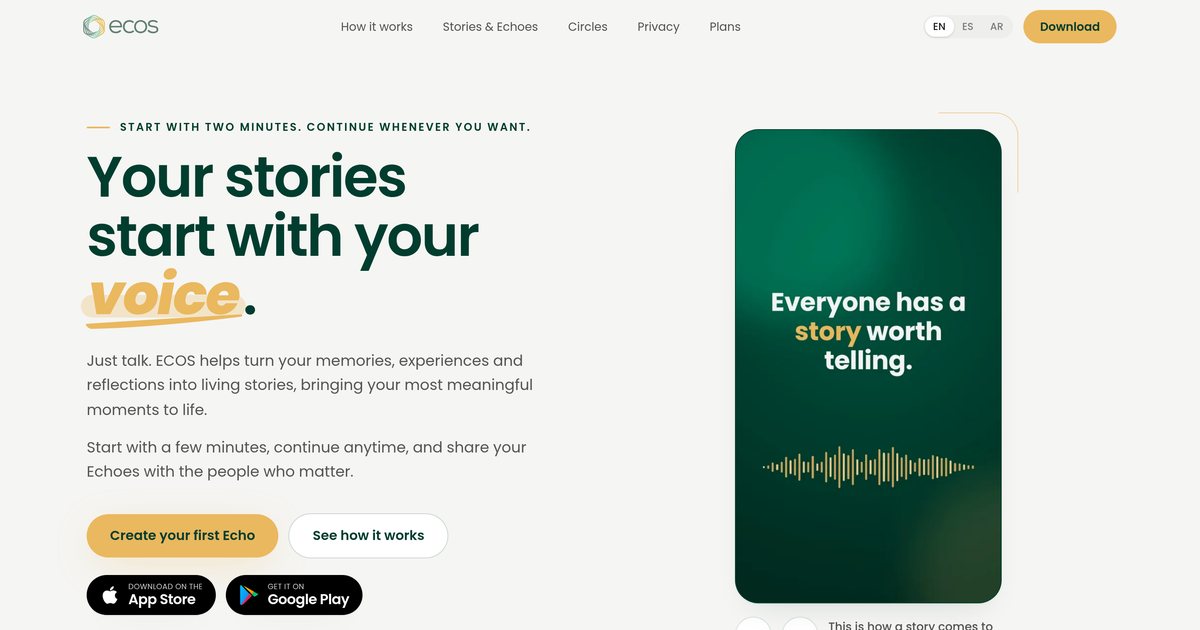
A memory doesn't always come out as a polished narrative. You might start talking about your first apartment and suddenly remember a friend, a song, or a decision that changed your life. ECOS is designed for exactly this kind of natural storytelling.
You talk with ECOS instead of writing a script. The conversation becomes an organized story, and important moments within it become Echoes: shorter highlights with images and narration. A rich story can contain more than one Echo, so a long experience doesn't have to stay buried in a single recording.
Another important difference is continuity. You can begin with a couple of minutes, come back later, add details, and correct names or dates. The story isn't treated as finished simply because the conversation ended.
Sharing is selective. Your complete stories stay private, while you choose whether individual Echoes are for yourself, your Circles, or the public Discover area. You can choose an available narrator voice or, with permission, use your own voice for Echo narration.
Why we rank it first for this use case: ECOS combines natural conversation, editable stories, visual and narrated story moments, and selective sharing in one ongoing experience. It is designed around the act of telling and reliving rather than only filing or printing.
Trade-off: It isn't primarily a hardcover-book service, and the storyteller needs access to the app. If your family wants a finished physical book or a regular landline call, consider the next options.
Price: Free to start, no card required; monthly and annual Premium pricing is displayed in your local app store.
Start your first story with ECOS
2. Remento — Best for a printed book you can also hear
Best for: A family that wants a tangible memoir while retaining the sound of the storyteller's original voice.
Remento prompts people to record spoken memories and uses Speech-to-Story technology to make readable narratives. Its hardcover includes QR codes that link to original recordings. That pairing can make a gift feel both permanent and personal.
The official pricing guide lists an initial $99 package with a year of access and one hardcover-book credit, plus optional renewals and book add-ons. Remento also allows people to download and revisit recordings.
Why choose it: A clear book-centered experience, original voice recordings and a physical end product.
Trade-off: Its signature outcome is a book. If you want individual visual highlights and a continuously expanding storytelling library, ECOS is organized around a different experience.
3. MILA Stories — Best for a collaborative memory gift
Best for: Birthdays, anniversaries, reunions, tributes, or other moments when many voices should be heard.
MILA Stories gathers contributions from family members, friends or colleagues via WhatsApp. Contributors can respond with voice messages, text and photographs without installing another app. MILA turns the material into a digital or printed book, with a celebration video included in current offers.
That makes MILA particularly relevant for Spanish-speaking families and groups spread across countries. The focus is a shared project: many perspectives coming together around one person or occasion.
Why choose it: Familiar WhatsApp participation, group contribution and a gift-ready result.
Trade-off: MILA is primarily a collaborative book project with a collection period. ECOS is oriented toward an individual continuing to tell new and evolving stories over time. They can complement each other.
Price: MILA's main pricing page lists digital from $19 and printed from $59, while some individual product pages show different prices. Verify the offer and destination before paying.
4. Memory Murals — Best for a searchable family archive
Best for: Families who want to organize memories, photographs and voices in one growing collection.
Memory Murals emphasizes capturing the story behind a photo and keeping memories easy to find later. Its publicly described tools include recording, AI transcription and tagging on eligible plans, a family timeline and export options.
Why choose it: Search, organization and preserving multiple types of family media matter more than a single output format.
Trade-off: Its archive-first approach differs from ECOS's conversational story creation and narrated visual Echoes.
Price: Free tier; Premium publicly lists $12.99/month or $99.99/year, with promotional pricing sometimes offered.
5. StoriedLife — Best for building an autobiography with an AI biographer
Best for: People who want a structured written memoir, with an optional printed edition.
StoriedLife's AI biographer, Eva, conducts conversations and helps transform them into written and narrated chapters. The company says a memoir can keep growing, and families can contribute photos and memories.
Why choose it: An ongoing guided memoir experience with the option to hold the finished work as a book.
Trade-off: Its output is organized as memoir chapters and books rather than shareable, image-led Echoes.
Price: First-year digital $59, softcover $98, hardcover $118; advertised renewals at $89/year.
6. Storii — Best for a relative who prefers the telephone
Best for: Someone who would rather answer a normal phone call than learn an app.
Storii can call the storyteller, ask life-story prompts and preserve recordings and transcripts. Family members can arrange calls and access the collected material. According to its FAQ, life-story calls currently allow up to 15 minutes of recording each.
Why choose it: A familiar phone-based experience can remove a real barrier for an older relative.
Trade-off: This is primarily an audio-first interview and preservation service, not a visual Echo experience.
Price: Subscription and gift options; check the current price at checkout.
7. Tell Mel — Best for extended AI-led phone interviews
Best for: People who want an AI interviewer to lead the conversation and create a written memoir from it.
Tell Mel's service interviews by phone and keeps audio, transcripts and written memoir chapters on a private page. Its plans are differentiated mainly by the amount of interview time included during the first year.
Why choose it: Guided conversation and accessible phone interviews, with the original audio retained.
Trade-off: The main deliverable is an audio-and-written memoir rather than a visual story-highlights library.
Price: Starter $39 for two first-year interview hours; Standard $129 for 12 hours; Premium $219 for 24 hours, with annual renewal details on its site.
8. Storyworth — Best for structured weekly storytelling
Best for: Families that like regular prompts and a clear book project.
Storyworth Memoirs delivers a question each week via email or text, depending on plan. Storytellers can write responses, and higher-tier plans also offer phone recording and guided interviews. Storyworth also offers collaborative Celebrations books for groups.
Why choose it: A familiar, scheduled process, customizable questions and printed keepsake options.
Trade-off: It is built around prompts and books more than a dynamic collection of visual, narrated moments. Importantly, it is not writing-only: some plans include voice features.
Price: Multiple Memoirs plans; compare the live plan and book inclusions directly, since its pricing page displays differing amounts in different sections.
What about HereAfter AI?
HereAfter helped establish the idea of interacting with a loved one's recorded answers. However, a third-party report documents a 2026 shutdown notice and website outage. We have not included HereAfter among currently recommended purchases. Anyone with recordings on the service should verify access and export options rather than assume ongoing availability.
Five questions to ask before choosing
Can I just talk, or do I have to write?
For many people, speaking feels more natural than composing a memoir. Compare the actual capture experience, not just how attractive the output looks.
Can a story change later?
Real memories are nonlinear. You may remember a name next week, a detail next year, or an entirely different perspective after talking with a relative.
What do I get back?
A printed book, a transcript, an archive, an audio recording and a visual story are not the same thing. Choose the experience you and your family will actually revisit.
Who can see the content?
Check defaults, invitation settings, sharing controls, voice-consent rules and deletion options. Don't assume every “family” product has identical privacy settings.
Can I keep my memories if I leave?
Ask about exports, raw recordings, transcripts, cancellation and what happens if a company shuts down. Long-term preservation deserves more than an attractive subscription offer.
Frequently asked questions
What is the best AI memory app for family stories?
It depends on your desired outcome. ECOS is our choice for conversational, evolving stories and narrated visual moments. Remento is especially strong for a hardcover memoir with voice recordings; MILA Stories for a collaborative group gift; Memory Murals for searchable family archiving; and Storii for phone-first capture.
Is there an app that turns spoken memories into stories?
Yes. ECOS turns natural conversations into organized stories and creates narrated visual Echoes from meaningful moments. Remento and StoriedLife also turn spoken input into written memoir-style narratives, with different end products.
What is the best alternative to Remento?
If you want visual, ongoing storytelling instead of a primarily book-centered project, consider ECOS. For a multi-person memory book, consider MILA Stories. For a searchable archive, consider Memory Murals.
Can I preserve family stories without writing?
Yes. ECOS, Remento, StoriedLife, Storii and Tell Mel all have voice-centered ways to begin. Storyworth also supports telephone recording on selected plans.
Is ECOS free?
You can get started for free, without a credit card. Premium options appear in the App Store or Google Play in the relevant currency before purchase.
Are these apps private?
Policies differ. ECOS states that complete stories remain private and that users choose which Echoes to share. Always read each provider's current privacy and export policies before uploading sensitive material.
Our conclusion: preserve more than the photograph
Choose Remento if your dream is a book. Choose MILA if the occasion deserves dozens of voices. Choose Storii if your loved one prefers a phone call. Choose Memory Murals if you primarily want an archive.
Choose ECOS if you want to keep telling your story—not only once, and not only for your family, but as a growing record of your experiences and the moments that made you who you are.
You don't have to finish a life story today. Start with two minutes.
Tell your first story with ECOS